
Doubts about the Obama administration's commitment to a strategic partnership with India were raised by the likes of Lalit Mansingh, former Indian ambassador to the US and former Indian foreign secretary, and Kanwal Sibal, former Indian foreign secretary and former deputy chief of mission in Washington, DC, in two separate panels titled 'American and Indian Strategic Interests in Asia' and 'Where is the US-India Strategic Relationship Headed in the Coming Year?'

Prime Minister Narendra Modi on Thursday said he would join the Association of Southeast Asian Nations (ASEAN)-India Summit virtually in Malaysia next week.
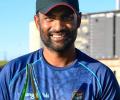
A senior Bangladesh Cricket Board (BCB) official has found himself at the centre of a major controversy after branding former Bangladesh captain Tamim Iqbal an 'Indian agent', triggering widespread backlash across the country's cricketing fraternity.
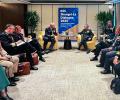
Top military officials from India and Pakistan highlighted their views at the Shangri-La Dialogue in Singapore, billed as Asia's premier defence forum, amid heightened tensions between the two sides following last month's military confrontation.

Pakistan's Air Force Chief Zaheer Ahmed Baber Sidhu visited the US to enhance bilateral defence cooperation, following a similar visit by the Army Chief. The visit included meetings with US military and political leaders to discuss regional security, counter-terrorism efforts, and future cooperation.
Pakistan and the United States are set to hold their first strategic dialogue on Wednesday, but the focus will squarely be on powerful army chief Ashfaq Parvez Kayani, who has played a key role in shaping the government's approach to the parleys, which are expected to cover Indo-Pak ties and Afghanistan. General Kayani, who is currently visiting the US at the invitation of Central Command chief General David Petraeus, will participate in the ministerial-level strategic talks.
US Secretary of State Hillary Clinton and Pakistani Foreign Minister Shah Mahmood Qureshi would co-chair the first US-Pak Strategic Dialogue to be held in Washington on March 24.
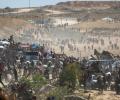
India has called for a ceasefire, release of all hostages, and peaceful resolution of the Israel-Hamas conflict through dialogue and diplomacy. The Centre informed Parliament that India welcomed the agreement on the first phase of the Gaza Peace Plan. The article also covers India's energy sourcing strategy and the release of Indian fishermen by Pakistan.

Prime Minister Narendra Modi visited Ethiopia on a bilateral visit, engaging with Ethiopian leadership to strengthen partnerships in various sectors. He was warmly welcomed by Prime Minister Abiy Ahmed Ali and participated in cultural events, highlighting the strong ties between the two nations.
Addressing a joint press conference in Washington along with Pakistan Foreign Minister Shah Mehmood Qureshi, US Secretary of State Hillary Clinton said that over the next few days the strategic talks will focus on Pakistan's energy and water needs.
"How can you have a strategic dialogue without including the military," Special US Representative for Pakistan and Afghanistan Richard Holbrooke told reporters at the Foggy Bottom headquarters of the State Department.
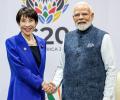
If they act now, they can reshape the strategic map of Asia without firing a shot. If they wait, the next opportunity will come only after a serious Taiwan Strait incident -- by which time the price will be far higher, and the room for boldness far smaller -- the opportunity may well be lost by then. The question is no longer whether this can or should be done, points out Varun Arya.

Chief Justice of India lays the foundation for an Integrated Judicial Court Complex in Assam's Kamrup district, facing protests from the Gauhati High Court Bar Association (GHCBA) over the relocation of the High Court.
'Can a nuclear-armed nation sustain itself indefinitely under overt military rule without catastrophic consequences for itself and the region? History suggests otherwise.'

India and Russia are poised to sign multiple agreements to bolster cooperation in various sectors, including trade and healthcare, during Russian President Vladimir Putin's visit to New Delhi. Discussions will also address the Ukraine conflict and efforts to increase Indian exports to Russia.
Gen Chauhan said a "whole of the nation" approach will be required to develop the shield.

'The background for the Saudi-Pakistan agreement is the fact that the regional security order has collapsed due to the Israeli attack on Doha.' 'The Americans have largely abandoned their security guarantee for West Asia and the region has no choice but to look at alternatives.'

India and the US have signed a framework agreement for defence cooperation for the next 10 years, enhancing their partnership and aiming for regional stability.

Twelve Indian Super League (ISL) clubs on Thursday urged the All India Football Federation (AIFF) to amend the "commercially restrictive" clauses of its constitution during the Annual General Meeting (AGM) on December 20, in another reminder that the domestic game may collapse if immediate steps are not taken.
'Critics say the political leadership abandoned the army chief or did not back him. I disagree. 'Military leaders are trained to take decisions when given a free hand.' 'This was a clear go-ahead from the prime minister to the army chief.'
Chinese Foreign Minister Wang Yi stated that China mediated tensions between India and Pakistan, a claim disputed by India which maintains that the matter was resolved bilaterally.
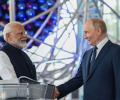
Prime Minister Narendra Modi conveyed to Russian President Vladimir Putin that India is ready to make all possible contributions towards a peaceful resolution of the Ukraine conflict.

India and China have reached new common understandings agreeing to conduct normalised management and control of the boundary during Foreign Minister Wang Yi's visit to New Delhi, Beijing said.

'Pakistan's role in Bangladesh will always be negative, since it's a one-point agenda is hostility against India.'

'We serve more than 1.2 billion trips annually and have over 1.5 million active earners each month using the platform.'

Prime Minister Narendra Modi and French President Emmanuel Macron discussed the Ukraine conflict and bilateral relations, reaffirming their commitment to global peace and stability.

Defence Minister Rajnath Singh claimed Jawaharlal Nehru wanted to build the Babri Masjid using public funds, but Sardar Vallabhbhai Patel prevented it. He also lauded Patel's contributions and criticized Nehru's approach to national issues.
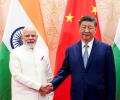
'What's currently underway is not a 'reset'.' 'What needs to be arrived at is a new balance.'

Pakistan's deputy Prime Minister and Foreign Minister Ishaq Dar, who is in China on a four-day visit, and Chinese Foreign Minister Wang Yi co-chaired the fifth round of the foreign minister-level China-Pakistan Strategic Dialogue.

After months of discord, the Tata Trusts appear to be moving towards reconciliation, with recent reappointments and open exchanges signalling a return to cooperative governance.
The second round of the Indo-United States strategic dialogue, co-chaired by External Affairs Minister S M Krishna and US Secretary of State Hillary Clinton, has been postponed in view of the Assembly elections in India and ongoing developments in West Asia and North Africa.

Chinese Foreign Minister Wang Yi said that it is imperative for the two sides to view each other as partners and opportunities rather than rivals or threats, and invest their valuable resources in development and revitalisation.

120 Bahadur is underwhelming, adding little fresh perspective and generally feeling like a standard war drama we have seen umpteen times before, notes Mayur Sanap.

India and Canada have unveiled a roadmap to boost cooperation in trade, critical minerals, and energy, signaling efforts to rebuild strained relations following the killing of a Sikh separatist in 2023. Discussions include addressing concerns over pro-Khalistan elements and pursuing a balanced partnership.

Russian President Vladimir Putin briefed Prime Minister Narendra Modi on his summit talks with US President Donald Trump on ending the war in Ukraine.

Prime Minister Narendra Modi condemned the violation of Qatar's sovereignty following Israeli air strikes on Doha, targeting Hamas leaders. He conveyed India's deep concern to the Emir of Qatar and reiterated support for peace and stability in the region.
A diplomatic row over a blind Chinese dissident overshadowed the inaugural meeting of the annual China-US strategic dialogue here after he sought American asylum for himself and his family over fears that "anything could happen" to them if they remained in the country.
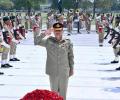
Creating a powerful new chief of defence forces has split the Pakistan military into four competing factions, points out Rana Banerji, who headed the Pakistan desk at RA&W.
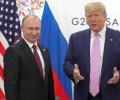
Taking to social media platform X, Dmitriev said, "Russia confirms Putin-Trump summit may happen next week and summit preparations are ongoing. This can be a historic meeting. Dialogue will prevail."

China showcased its latest military hardware, including hypersonic and ballistic missiles, during a parade commemorating the 80th anniversary of its victory against Japanese aggression in World War II. President Xi Jinping called for world peace and national rejuvenation.
